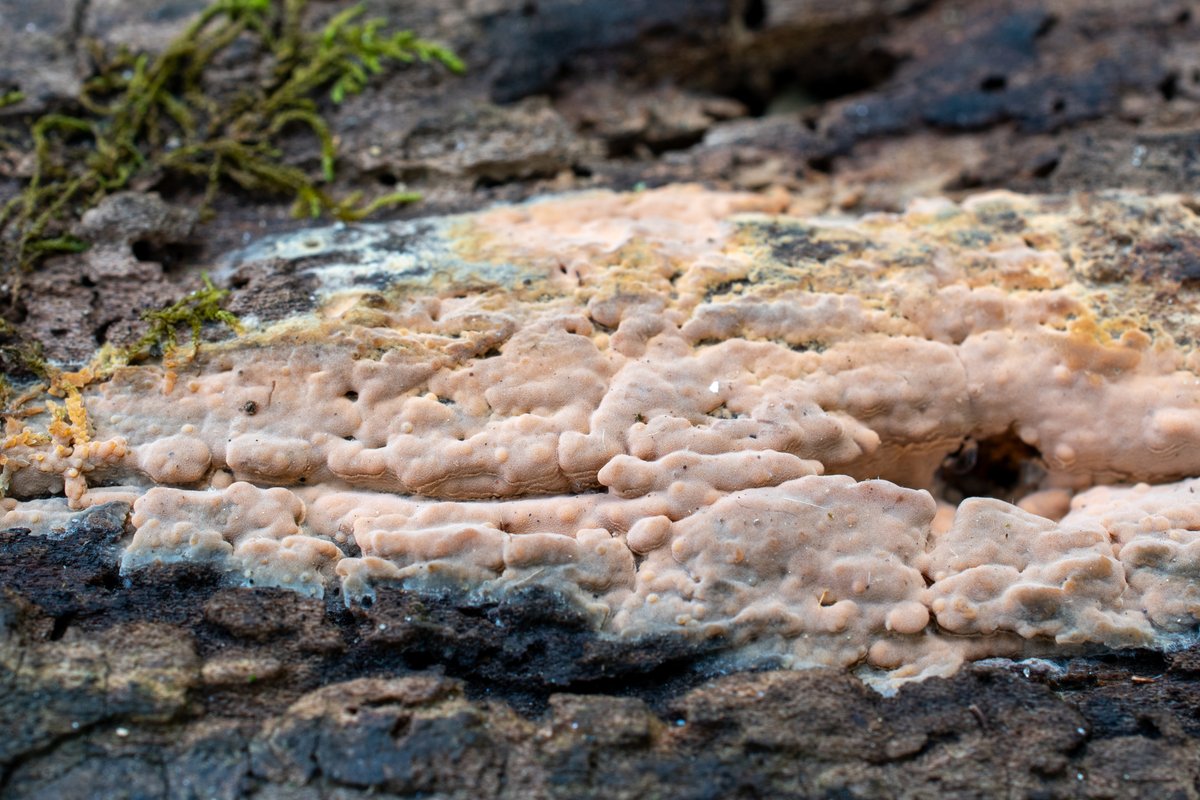
Basidiome

Basidiome

Basidiome

Close-up view of the basidiome showing the grandinoid hymenophore

Basidiome (Garrett Taylor, iNat34994361)

Basidiome (John Plischke, iNat93767747)

Dichohyphae in the subiculum

Gloeocystidium and dichohyphae

Amyloid, ornamented basidiospores in Melzer's reagent

Basidiospores in water

Basidiospores in water
Dichostereum effuscatum (Cooke & Ellis) Boidin & Lanq.


Dichostereum is a small, well-delimited genus of crusts with 15 accepted species. Like most fungi in the Russulales order, Dischostereum species produce ornamented basidiospores that have an amyloid reaction in Melzer's reagent (Deng et al. 2026). Dichostereum is closely related to Vararia, which also produces dichohyphae but has smooth spores instead of ornamented spores. While most Dichostereum species appear to have a narrow geographic range, Dichostereum effuscatum is widely distributed across temperate North America and Europe, but it is most common in Eastern North America (Bernicchia and Gorjón 2010, Liu and He 2018). Few studies have been conducted on this species, and those that exist focus primarily on its systematics, meaning we don't know much about Dichostereum effuscatum beyond its position in the fungal phylogeny.
Detailed species information is also available at mycoquebec.org.
Details
Saprotrophic on deciduous wood.
Fresh basidiocarp yellowish, peachy, pinkish, salmon-orange, or orangish, bruising brown. Resupinate, effused, with a smooth to grandinoid hymenophore and ceraceous to crustaceous consistency. Margin indeterminate.
Not determined.
Ammonia and iron salts not absorbing, effectively negative. KOH darkening the hymenium.
Creamy yellow or peachy.
Temperate Europe and North America. Uncommon in Europe and Western North America, common in Eastern North America. View all sequenced specimens on iNaturalist.
Microscopy
Hyphal system: Dimitic with thick-walled dichohyphae and clamped generate hyphae. The dichohyphae are supposedly dextrinoid but the color reaction is difficult to see. Basidia: With four sterigmata, difficult to observe amongst the compact hymenium and dichohyphae. Basidiospores: Subglobose, amyloid, ornamented with splotchy surface warts, containing one large guttule, typically wider than long (like a squat orange); length (6.3) 6.7-7.4 (8.1) µm, x̄ = 7.1 µm; width (5.6) 5.9-6.6 (7.2) µm, x̄ = 6.2 µm; Q (1) 1.1-1.2 (1.3), x̄ = 1.1 (n = 30 per specimen). Sterile structures: Gloeocystidia.
Studied Specimens
ACD0699 (iNat131672147). Collected by Maricel Patiño. 19 April 2022. Burlington Co., NJ, USA, 39.9778, -74.7385. ACD Personal Collection. Sequences: OR680686 (ITS).
ACD0787 (iNat321982130). Collected by Alden C. Dirks. 19 October 2025. Crum Woods, Swarthmore College, Delaware Co., PA, USA, 39.9019, -75.3610. ACD Personal Collection. Sequences: MycoMap (ITS).
References
-
Bernicchia A, Gorjón SP. 2010. Corticiaceae s.l. Italia: Candusso. 1008 p. Link
-
Deng Y, Chen M, Zhang S, Wang K, Liu W, Qiu Y, Dou Y, Liu X, Wijesinghe ASN, Zhou H, Jabeen S, Zhao C. 2026. Notes, taxonomy, and phylogeny of wood-inhabiting fungi in Russulales. Mycosphere 17. PDF Link
-
Liu S-L, He S-H. 2018. Taxonomy and phylogeny of Dichostereum (Russulales), with descriptions of three new species from southern China. MycoKeys 40:111–126. PDF Link
Citation
Dirks, Alden. 2026. Species profile for Dichostereum effuscatum (Cooke & Ellis) Boidin & Lanq. CrustFungi.Com. https://crustfungi.com/species/dichostereum-effuscatum/. Accessed 2026-10-19.