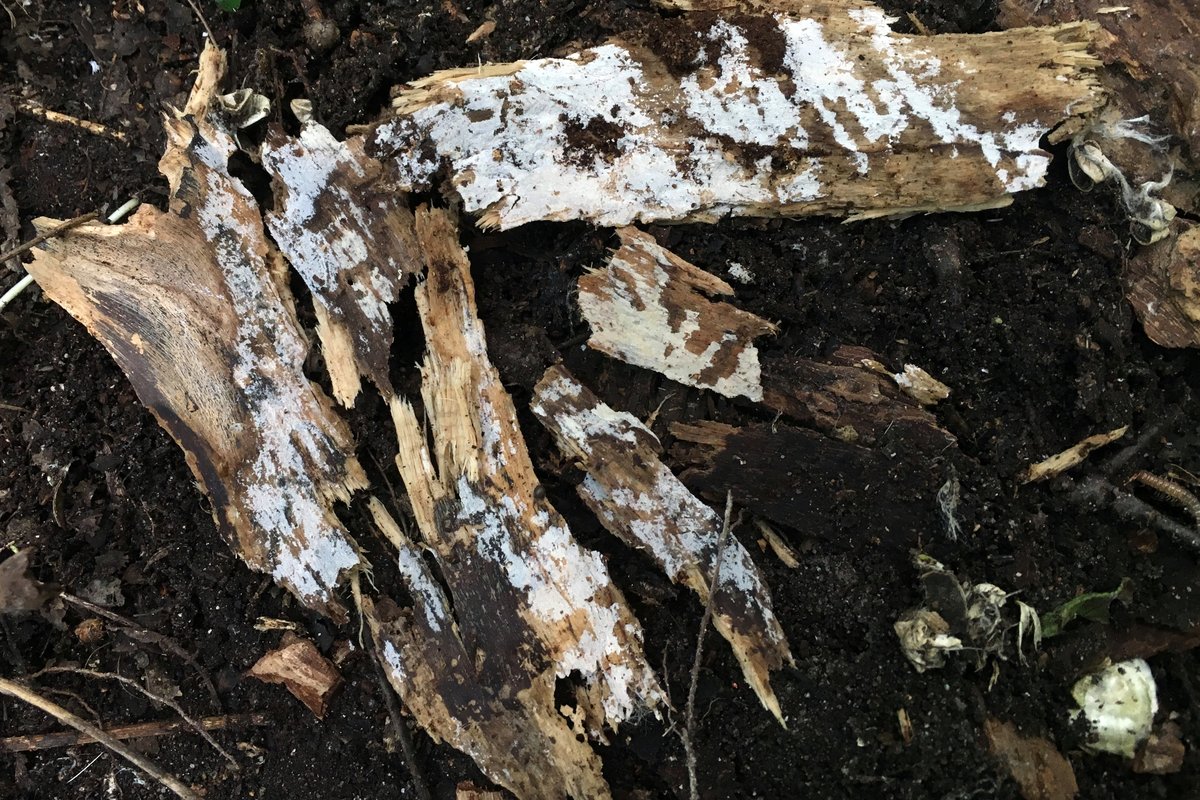
Thin, white basidiocarp

Basidiospores

Subulicystidia

Subulicystidia
Subulicystidium sp. 'WI01'
The genus Subulicystidium consists of 24 species and is characterized by amazing subulate (tapering to a point) cystidia with rectangular crystals that encircle the cystidia in rows or spirals (Liu et al. 2022). And poking out of the top of each cystidium is a hypha, which runs through the center of the barb-like structure like a worm. Who knows the adaptive function of these strange microscopic structures, but to me they look like they are for defensive purposes, perhaps against the many animals that graze on crusts.
Based on morphological similarity, the studied specimen was originally identified as Subulicystidium brachysporum. Subulicystidium brachysporum was described in 1958 growing on the underground timbers in a gold mine in South Africa (Talbot 1958) — I never considered how fungi could be eating the old wooden support systems of mine shafts and might be responsible for their collapse! Molecular phylogenetic studies indicate that the S. brachysporum morphogroup is highly polyphyletic (Ordynets et al. 2018). Most sequenced material from this group is from the Southern Hemisphere. Pending further investigations, this species has been assigned the temp. code Subulicystidium sp. 'WI01'.
Details
Growing on wood, presumably saprotrophic.
White, effused, resupinate basidiome with a smooth hymenophore.
Not determined.
Not determined.
Not determined.
Currently known from a single sequenced collection from Wisconsin. View all sequenced specimens on iNaturalist.
Microscopy
Hyphal system: Monomitic, encrusted, clamped, subicular hyphae somewhat thick-walled, width (3.6) 3.9–5.1 (5.3) µm, x̄ = 4.5 µm (n = 10). Basidia: Repetitive basidia with four sterigmata, about 15 ✕ 5 µm, reported as 13-17 ✕ 3-4 µm (Talbot 1958). Basidiospores: Narrowly cylindrical to allantoid, thin-walled, hyaline, inamyloid; length (6.4) 7.5–8.8 (9.4) µm, width (2.2) 2.5–2.9 (3.2) µm, x̄ = 8.2 ✕ 2.7, Q (2.1) 2.7–3.3 (3.5); biguttulate (two equally sized oil droplets situated at the poles of the spore), rarely one or three guttules, diameter (1.2) 1.3-1.6 (1.6) µm (n = 30). Sterile structures: Subulicystidia.
Studied Specimens
UWMA0061 (iNat172305516). 23 June 2018. University of Wisconsin Arboretum, Dane Co., WI, USA, 43.0563 -89.4055. Kriebel Fungarium (PUL00047282). Sequences: MW448634 (ITS).
References
-
Jülich W. 1975. Studien an cystiden—I. Subulicystidium Parm. Persoonia 8:187–190. PDF Link
-
Liu S, He S, Wang X, May T, He G, Chen S, Zhou L. 2022. Trechisporales emended with a segregation of Sistotremastrales ord. nov. (Basidiomycota). Mycosphere 13:862–954. PDF Link
-
Ordynets A, Scherf D, Pansegrau F, Denecke J, Lysenko L, Larsson K-H, Langer E. 2018. Short-spored Subulicystidium (Trechisporales, Basidiomycota): high morphological diversity and only partly clear species boundaries. MycoKeys 35:41–99. PDF Link
-
Talbot PHB. 1958. Studies of some South African resupinate hymenomycetes. Part II. Bothalia 7:131–187. PDF Link
Citation
Dirks, Alden. 2026. Species profile for Subulicystidium sp. 'WI01'. CrustFungi.Com. https://crustfungi.com/species/subulicystidium-sp-wi01/. Accessed 2026-03-31.